
Railofy
Startup on a mission to solve the pain of 300M train travelers in India


Welcome to issue #3 of Just Seeded. This post is a little different from my previous posts due to the following reasons:
In addition to sharing my understanding of Railofy's business, I am adding insights taken directly from Rohan, Co-founder & CEO of Railofy
This is my first post about a startup from India, solving a problem unique to India 🇮🇳
Index:
🚂 What does Railofy do?
🚂 What problem is it solving?
🚂 Q&A with Rohan Dedhia, Co-founder & CEO, Railofy
🚂 Why do I think Railofy has huge potential?

If you travel by a long-distance train in India, you would generally reserve a seat. As trains on most routes operate at more than 100% capacity, you would want to book your ticket well in advance (read - months in advance). However, despite your in-time efforts to make a booking, there is a high possibility you would not get a confirmed seat instead, you would get a ticket with a "Waitlist" status. The concept of Waitlist is pretty self-explanatory - you are waiting to be confirmed - but using it in the context of train travel could be quite unique to India (or to the subcontinent) in present times.
The implication of Waitlist status is you will have to wait until a later date, in many cases, until the departure date to find out whether you can board the train or not. If the Waitlist status does not change to "Confirmed" you can not board the train. You would get a refund but this means that either you cancel your travel plans or buy a same-day, expensive flight ticket. From the day of making the reservation until the travel date, a waitlisted traveler faces huge uncertainty and cost if he decides to take an alternate mode of transport on the same day. There are around 300M bookings that get waitlisted every year in India.
(To readers who are more familiar with air travel and finding it difficult to relate to the problem, think of booking a flight and the airline tells you that you are on the waitlist. You would only find out whether you could fly or not on the day of travel.)
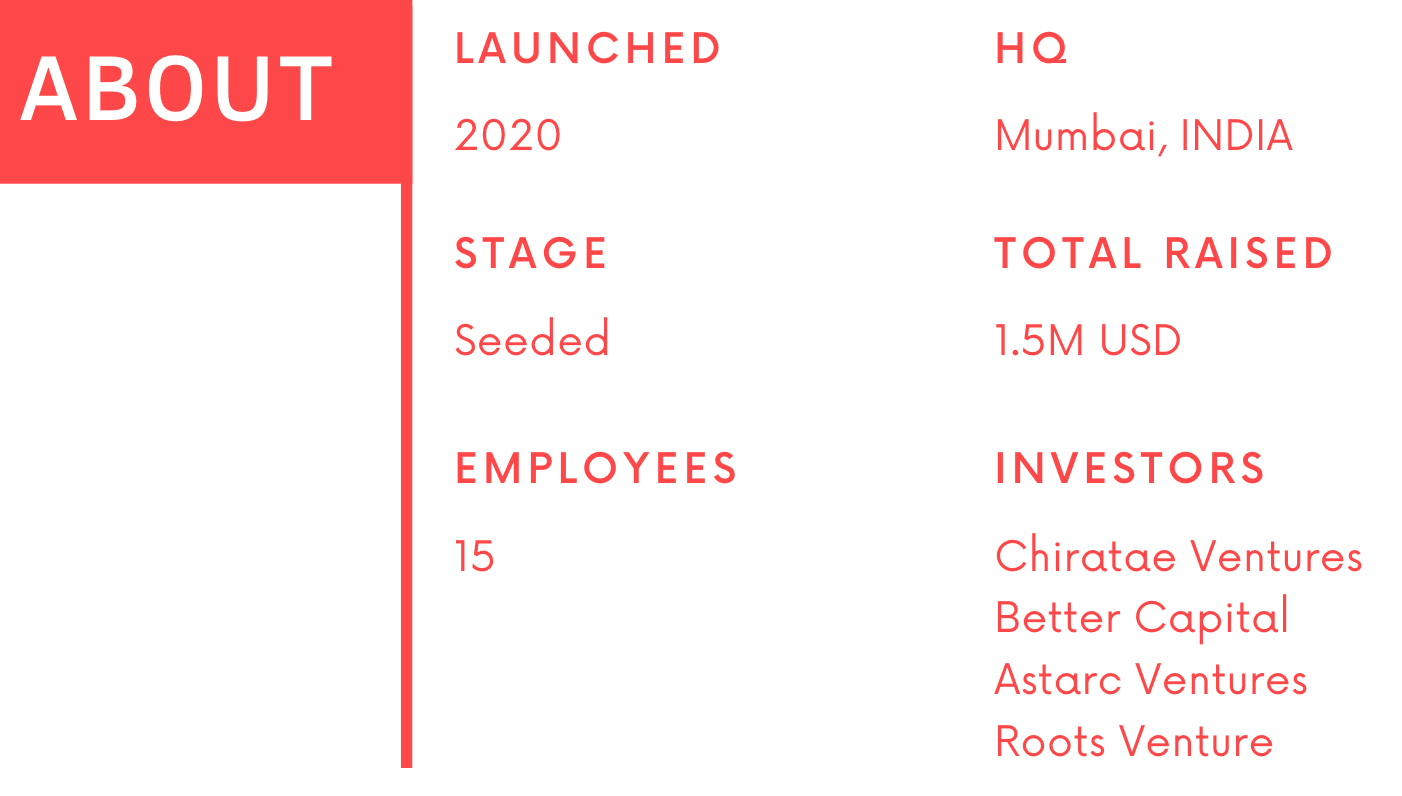
For such waitlisted travelers, Railofy provides an “option” to travel by flight at a similar price as the train ticket. Railofy helps a waitlisted traveler in two ways.
It removes the uncertainty in regard to the travel plan.
It removes the risk of paying an exorbitant price for an alternate mode of transport.
Those of you who are not too familiar with how India's massive railway system works might already be wondering 😕
Why would you book a train for months in advance? Why can't you buy a ticket and board the damn train 🚞?
If you book in advance, why would you NOT get a confirmed seat 💺?
Why would you have to be on the waitlist 📋 for a train?
Why don't you buy a flight ticket ✈️ in the first place if your seat is not confirmed?
All valid questions! To understand and appreciate Railofy's value proposition, let me explain a bit more about the context - The Indian Railways.
The Great Indian Railways Problem 🧗🏼♂️
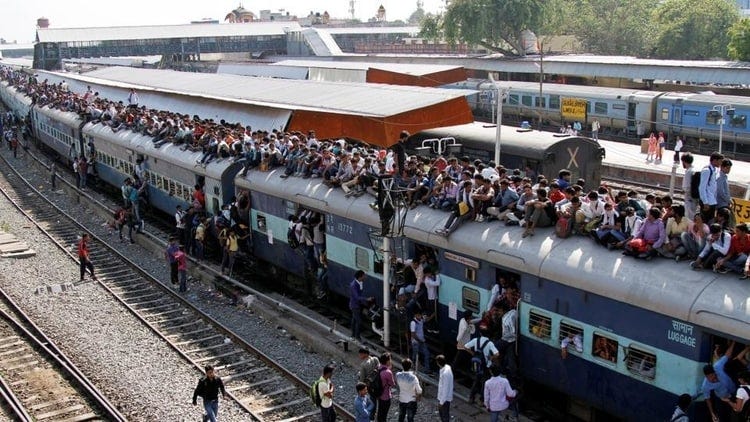
With 63,000 km of rail routes and 7000+ stations, the passenger rail network in India is the third biggest in the world after Russia and China. It is run by the Indian Government, under the Railway Ministry, and it employs over 1.4 million people, making it one of the largest employers in the world. There are multiple types of passenger trains but let me focus only on long-distance trains. The longest single train journey is around 82 hours, 8-20 hours of the train journeys are common in the country. In a long-distance train, there are multiple categories of seats available with varying levels of comfort, with fares starting at a few dollars going as high as 100 dollars. The Indian government has kept the price low to provide an affordable mode of transport to the masses. This generally results in high demand for seats compared to the supply. In 2019, Indian railways transported 8.4 billion people compared to 100 million people that traveled on domestic flights. (India is the third-largest aviation market in the world growing at a double-digit CAGR but air travel is still aspirational for the majority of Indians)
All long-distance trains provide an advance seat booking facility that lets a traveler book a seat up to 120 days prior to the travel date but as we discussed above, a large number of people get waitlisted. The reason lies in the working of the train reservation system in India.
(for simplifying, I have skipped some details. If there are any train aficionados, I apologize in advance)
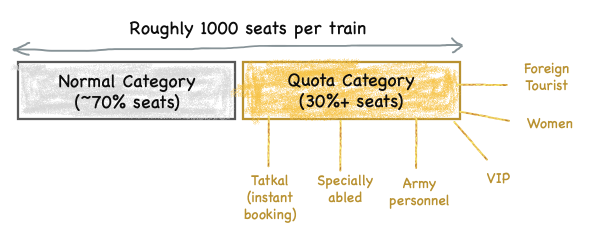
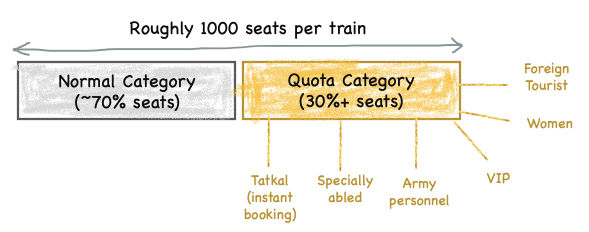
Train seats are allocated to "Normal" and "Quota" categories. The Normal category seats are open to book for everyone (no surprise 🥱 ). In the Quota category, a certain percentage of seats are kept for people with special needs or rights. As the Railways is the primary mode of transport, the government wants to make sure that people who are needed for various services such as Army, Media, Ministry personnel, or people that are dependent on the government for support, etc. get access to travel, so they created Quota systems on train.
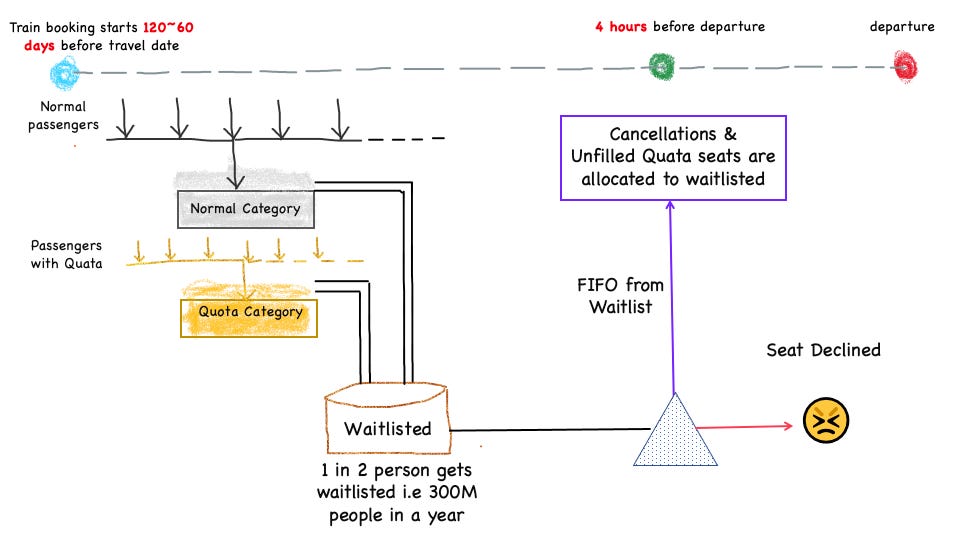
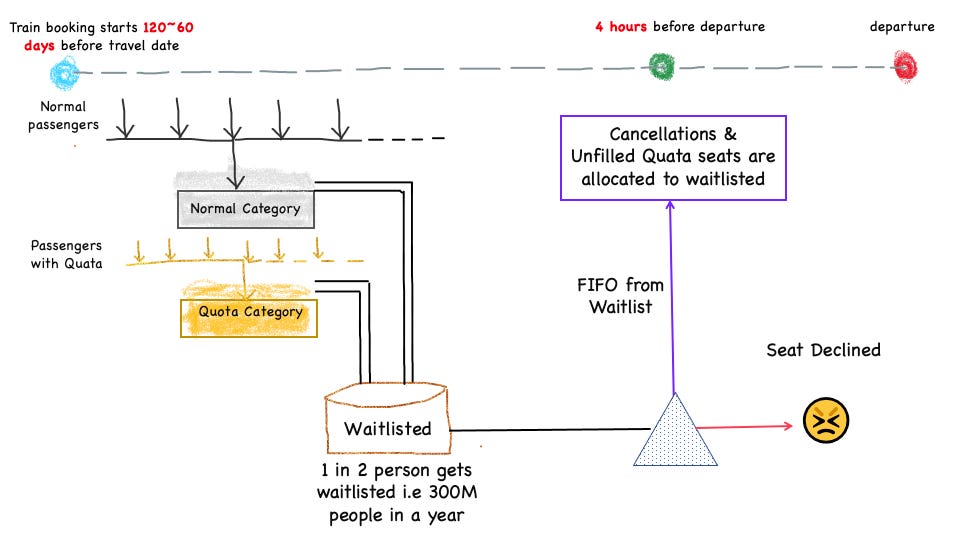
There are three points on the timeline on train booking and seat allocation.
1. The day from when the booking starts
2. 4 hours prior to the departure date
3. DepartureAfter the booking starts, first, the seats in the Normal and Quota category fill up. Once a category is full, the incoming reservation requests are allocated to the waitlist category. (If there are any cancellation in the Normal category, a traveler in the waitlisted category is upgraded to confirmed) 4 hours before the departure, any unallocated seats in the Quota category or any last-minute cancellation are assigned to passengers on the waitlist. At this ‘4 hours before departure’ point, a person on the waitlist finds out whether he is able to travel or not.
Indian Railways' system optimizes for a large, diversified nation where a large population has limited economic means. I hope this explains the concept of the waitlist and why uncertainty is unavoidable in the current model.


JS: Before we start discussing Railofy, I would like to know the human story behind Railofy. How did you go from being a consultant at KPMG to founding Railofy?
After ISB (Indian School of Business), I started working in consulting at KPMG and after few years I wanted to try something else. Venture Capital was never on my mind because first, I did not know much about the industry, and second, I thought you need to know a lot about technology. I got connected to a partner at Orios Venture Partners through an ISB alum and I applied for the Associate role. As they say, strange things do happen in life, I got selected and became the first employee at the firm. As we were a very small team I got to source and lead several investments, and also worked on fundraising for the fund.
The time I spent at Orios was transformative for me. Without it, I would never have been able to take a shot at entrepreneurship. In venture capital, you are constantly looking for new things to back. This experience of looking at problems and building a business to solve them was an eye-opener. In fact, I came with the idea of Railofy at Orios. It is an interesting story.
To source investments, I used to go to almost every conference and talk to everyone to network. At one of these conferences, I met an entrepreneur who built an app to check the PNR status and predict whether a waitlisted ticket would confirm. He had amazing DAUs (daily active users) and MAUs (monthly active users) because people with waitlisted tickets would keep checking once or twice a week and almost daily as the travel date nears. As an inquisitive investor, I started learning about the problem, the opportunity and found out that there are more than 300M people who get waitlisted every year and face huge uncertainty. To put things into perspective, there are about 200M people who now use e-commerce and around 144M who fly (domestic + international) every year. If we keep the purchasing power aside, the waitlisted passenger segment would be the largest untapped market out there. There are many apps or sites that let you check PNR status and they make money by showing you ads. It is not common for a travel-related site to make money from advertisements and if we look at the active user numbers, many of them would be at par with large OTAs in the country. I got more sucked into the idea and started Railofy that we launched to the public in Jan 2020.
”There is common wisdom in the VC circle that models that were validated in the US or China have low risk to fund but the problem I am trying to solve has no prior validation and it is very unique to India. This is the reason I call myself an immature entrepreneur.”
JS: Since you discovered the problem to until you quit your job to build Railofy, what gave you the confidence that you can actually solve this problem?
Around 2014, Fintech started emerging in India and I led few investments in the space. A new way to underwriting (deciding whether to lend and at what price) based on data was emerging. I started thinking if there is a way to underwrite the uncertainty inherent to the Indian waitlist system. To find more, I started going to railway stations along with my wife and started observing the charts that contain the final list of passengers who are approved to board the train. These charts are put out for anyone to see just 4 hours before the departure. I closely observed the user experience of waitlisted passengers. Later, I hired few interns, who used to play from me in my cricket team to go to the three largest railway stations in Mumbai (approx 10% of India's train traffic) and take pictures of the train charts. Through this exercise, I collected enough data to start my analysis. I found that out of all the tickets that get waitlisted, a certain percentage gets confirmed. This gave me the confidence that I can underwrite this market and remove the pain of uncertainty.
JS: To people who buy a Railofy Option and don't get a confirmed ticket, you would provide them a flight ticket for the same day. How do you secure airline inventory? Was there a struggle in convincing airlines to work with your model?
“A philosophy we have is even when people, who we want to support us, say no to us, we build a relationship with them and ultimately ask them to help us figure out what we need to do"
Airlines in India sell 65% of the inventory at really low prices that are in the same range as train prices to attract travelers before a month of departure. The remaining 35% is priced at a higher price as the date of travel gets closer and it is the most money-making segment for airlines. We feel Railofy can help the airlines in the first segment by matching the surplus demand from railways to airlines. We are also building several models to fit specific cases. For example, a Mumbai-Delhi route for an airline would always be at a 97-98% load factor whereas a Mumbai-Jaipur would be at a lot lower load factor. In Railofy's model, we can optimize for the specific needs of the airlines and make a win-win product. What I can tell you is that opportunities exist, models evolve. We have an opportunity in front of us, we are optimizing our models and we already have airlines working with us.
JS: Out of all the people who get waitlisted, how do you identify your target customer segment?
Based on our extensive work on Indian railways, customer surveys, and interviews, and now what we see on our platform our understanding is that if 100 people get waitlisted and those who don't get confirmed, 36% would cancel their trip. They are very price-sensitive, they may not be our target segment. Next 34% are the ones who will actually travel through counter tickets. Counter ticket is a concept where you buy a ticket at the ticket counter at the railway station and hop onto the train to the general compartments. Although cheap, general compartments run on 120% utilization and the travel is going to be highly inconvenient. This may also not be our target segment. The remaining 30% is our target segment, which behaves as follows. 8% would take flights, 12% percent would take buses, and 10% use travel agents. The 30% of 300 million i.e. approx 100 million waitlisted users will be our target segment. This segment is willing to pay more to get to their destination.
JS: What are the key technology modules you built?
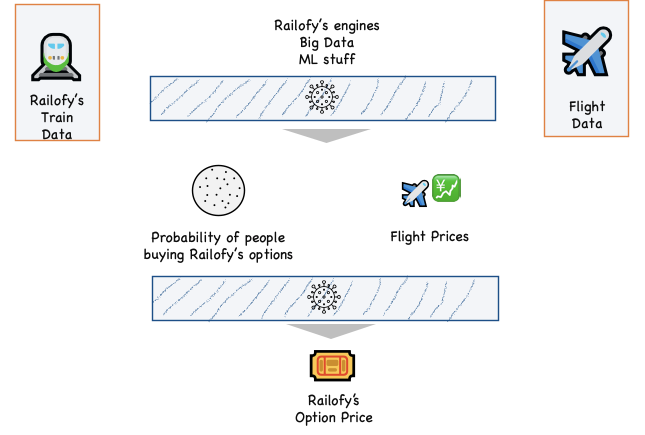
There are two key modules that we had to build. The first one is the data collection. As we have discussed, Railofy is an Option product and we have to predict how many passengers would not get confirm and at what price we would secure the inventory. To do this, we had to collect a lot of train data (waitlist data by train routes, seasons, classes, etc.), and we daily collect a lot of airline price data. Another key piece in our tech stack is our consumer-facing app. We do not consider our target segment as tech-savvy so we wanted to build a product that is intuitive and requires minimal familiarity with apps. The challenge in front of us was not only to build an easy-to-use product but also how to educate our customers about what is Waitlist protection. It is a new category that our segment would be exposed for the first time. We spent a lot of time figuring out the right UX. And the answer we came up with is the thing that works best for this segment is video. If you see our app today it is enabled only by video and voice.
JS: For Railofy to correctly price the option, it is essential that the Option price sold to a pool of waitlisted people should be accurate enough to cover the cost of the flight/ bus tickets provided to those whose tickets are not confirmed. This is essentially a data and prediction problem and the core technology Railofy is working on.
JS: The problem of uncertainty that waitlisted passengers face has always been there. As far as air travel in India is concerned, flights are offering really cheap rates since 10-15 years back. Why is now the right time to do this?
I have been asked this question in the past and I still don't have an answer. I will still try to respond to it retrospectively, which may sound a little biased. There are two reasons I see that led me to attempt this now. First, the data explosion and the emergence of Fintech was something that gave me the idea that data can also be used to solve the uncertainty issue that is inherent to this problem. Second, I believe that increase in capacity on the supply on the airlines' side. The growth in supply creates a challenge for liquidating the excess inventory which is pushing the prices down. A large portion of flight tickets is only is being offered at prices that are only slightly more expensive than premium trains. This trend makes Railofy's model feasible.
JS: After you decided to pursue the idea, how did you convince Vaibhav and Hrishab, your cofounders to join you?
I wanted to build this business with someone who connects to the problem statement. I talked to my ISB friend, Vaibhav - an IIT Bombay graduate. He is an avid train traveler and immediately connected with the problem. It took him one drink to come onboard. I met my third co-founder, Hrishab, who is a friend of my wife, a year later. As Railofy is tackling data and prediction problem, we needed someone who could build the models needed. Hrishab studied at IIM Lucknow and was heading the algorithmic trading desk at Edelweiss. He is also a visiting professor of machine learning at IIM Lucknow. For him, it's the opportunity to underwrite for 300M Indians using this expertise that got him to say yes immediately.
JS: At the seed stage when there is no brand, no funding, what is your approach to hiring the first employees?
My experience has been that if someone is really passionate about the problem statement, she would be the right candidate at the seed stage. I believe that expertise is not the most important thing, especially for an early-stage team. People with a passion for the problem would stick with you through all the uncertainty, even when there is no certainty about funding. With enough funding, expertise can be hired for later.
Parting thoughts
I believe the uncertainty people on the waitlist go through is a very tangible problem. As 300M people face the same problem every year, this could be one of the largest untapped consumer needs. If Railofy is able to educate people about their protection product and figure out an effective distribution strategy, I believe Railofy has the potential to become a default service people use every time they book a train.
I write based on my limited understanding of business and startups. This article is not investment advice. Please feel free to reach out at mayank@justseeded.com
Enjoyed reading this Mayank! Well researched and thorough. Would have also enjoyed more focus on the long term vision on how this space and product evolves